

Can You Keep Running a Business Through a Commercial Office Fitout?
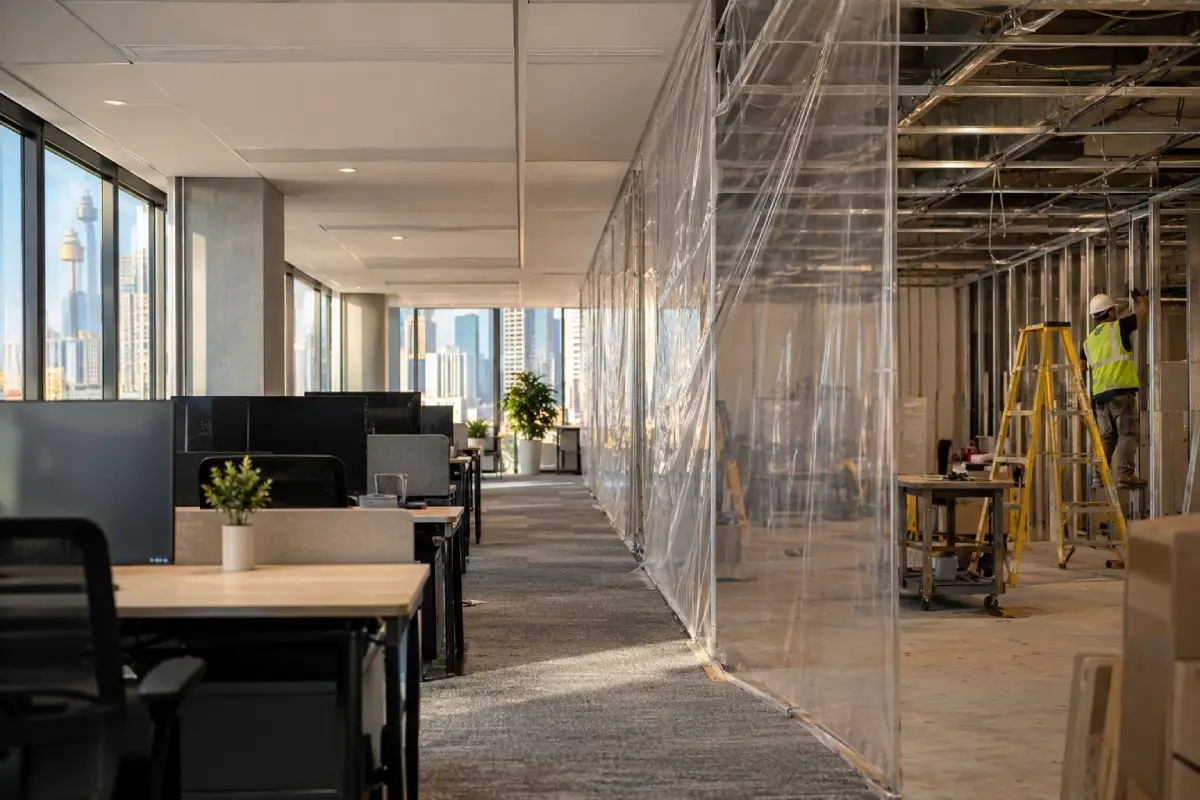
Quick answer: Usually yes. But it depends on your floor size, your headcount, and how much noise your work can absorb. Four delivery methods exist, and picking the wrong one costs you weeks.
Key Takeaways
- City of Sydney allows noisy site work only 7am to 7pm on weekdays in the city centre. Sunday work is banned.
- Four options: staged works, decant to swing space, after-hours program, or a short full vacate.
- Most delays happen before construction starts, not during it.
- Furniture is the top bottleneck. Imported pieces take up to 16 weeks.
- A mid-size Sydney fitout runs 12 to 24 weeks from brief to move-in.
Why Sydney’s Construction Hours Create the Problem
City of Sydney allows noisy construction in the city centre only from 7am to 7pm, Monday to Friday, and 7am to 5pm on Saturday. No work is permitted on Sundays or public holidays. Outside the city centre, the window is open from 7.30am to 5.30pm on weekdays and 7.30am to 3.30pm on Saturday.
Compare that to your own office hours. The legal window for demolition, drilling, and wall framing sits almost exactly on top of the hours your team needs to work. That overlap is the whole problem.
CBD towers add a second layer. Restricted delivery windows and lift bookings push high-rise projects past suburban sites every time. Your builder competes with every other tenant for the goods lift and loading dock.

The 4 Ways to Keep Working During a Fitout
1. Staged Fitout: Work Moves Through the Space in Zones
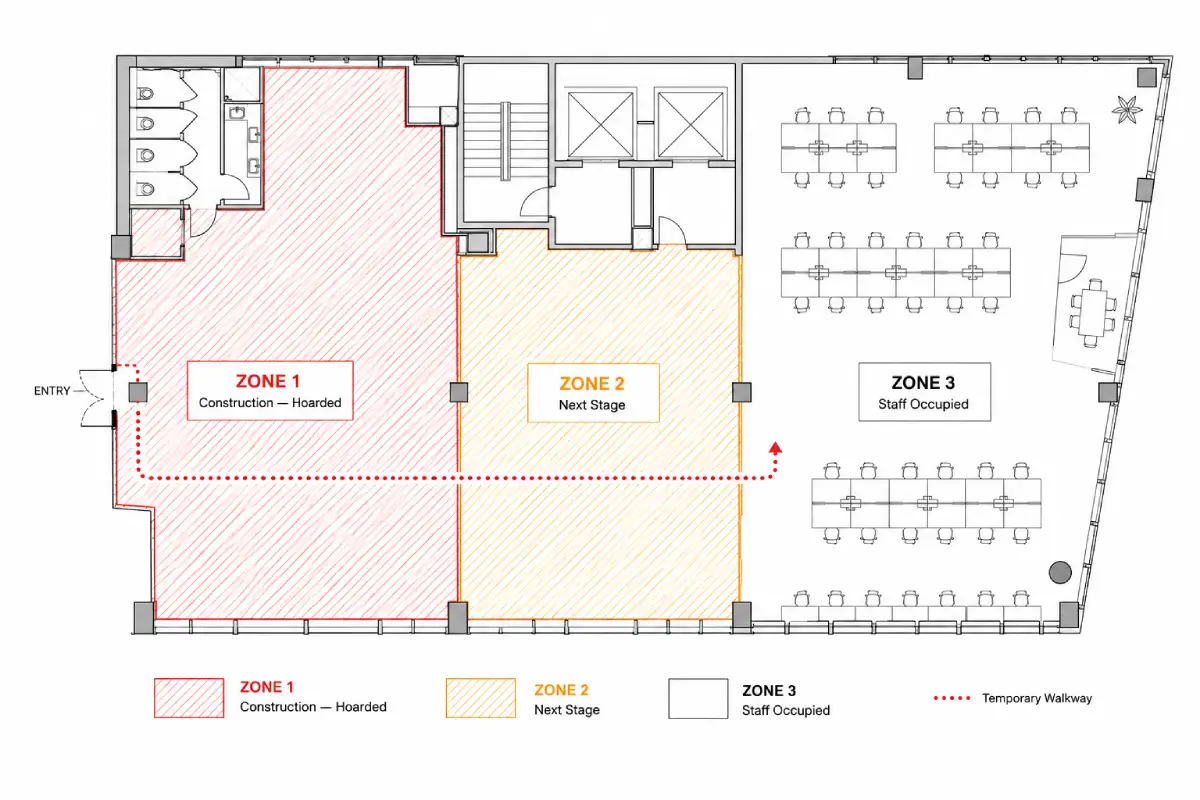
Your builder hoards off one zone, finishes it, moves staff in, then hoards the next.
Staging needs spare floor space. With 900 sqm and 60 desks, you can shuffle people around. With 180 sqm and 20 desks, you cannot. It also stretches the program, since every hoarding line means a second mobilisation and duplicate protection works.
The wet and dusty trades feel this most, since partition framing, plasterboard, ceilings, and painting all need clean handover between zones, and the same office partitions that create the hoarded zone during construction often become permanent meeting room walls afterward. Contractors like Pro Plaster N Paint, who handle partitioning, acoustic and fire-rated systems, suspended ceilings and painting across Sydney, deal with this sequencing constantly.
2. Decant: Everyone Leaves Briefly
You lease short-term space and your builder gets an empty site running at full speed. You pay rent twice and move twice, but you buy back weeks of program and remove the daily productivity drag. For small tenancies with heavy demolition, decanting often works out cheaper once you price staff downtime honestly.
3. After-Hours Program
Trades start at 6pm and finish before 7am, so your team walks into a cleaned site each morning. This suits core drilling, demolition and ceiling grid removal. It fails as a whole-project strategy: every trade carries a loading, the Sunday ban removes a day, and night programs run longer and cost far more.
4. Full Vacate With a Compressed Program
You accept a short shutdown, build hard, and reopen. For teams that can work remotely for two to four weeks, this is often the least disruptive option overall. The risk sits entirely on the completion date.
Side-by-Side Comparison
| Approach | Effect on Program | Cost | Daily Disruption | Best For | Main Risk |
| Staged fitout | Adds roughly 20 to 40% to construction | Moderate | High, lasts the whole build | Floor plates above ~600 sqm with spare desks | Staff patience wears thin by week four |
| Decant | Shortest construction phase | High: double rent, two moves | Two move days, then none | Small to mid tenancies, heavy demolition | Swing space lease misses the real handover date |
| After-hours | Extends program; no Sunday work | Highest per trade hour | Low in business hours | Targeted noisy tasks only | Trade fatigue, defects found late |
| Full vacate | Fastest calendar finish | Lowest construction cost | Total, then none | Teams that can work remotely 2 to 4 weeks | No fallback if handover slips |
Most Sydney projects end up as hybrids: a staged base program, demolition pushed after-hours, and a two-week decant only for the floor with the heaviest services work.
The 4 Decisions That Protect Your Business
Continuity is decided in the six weeks before anyone picks up a tool.
1. Order Long-Lead Items at Design Sign-Off
| Item | Lead Time |
| In-stock chairs and standard desks | 2 to 4 weeks |
| Made-to-order local benching and joinery | 6 to 10 weeks |
| Imported European or US furniture | 10 to 16 weeks |
| Custom glass partitions | 3 to 5 weeks |
| Specialist or imported flooring | 4 to 6 weeks |
For a 10 to 14 week construction program, place furniture orders no later than week 2 to 4, and order imported pieces at design sign-off. Tenants who choose to move in late move into a finished space and sit on hired chairs for a month.
2. Treat Approvals as Real Program Activities
Landlord consent usually takes two to four weeks once you submit plans, contractor details and insurance certificates. Most Sydney buildings also require a Fitout Consent Application, reviewed in one to three weeks. Put both on the Gantt chart with a named person chasing them. Approvals sitting in an inbox are the cheapest delay to prevent.
3. Sequence the IT and Phone Cutover First
Your business does not stop because a wall is unpainted. It stops because the phones went down. Map every cutover to a specific night, confirm it in writing with your provider, and build a rollback plan. Friday nights give you a weekend of margin.
4. Write the Access Rules Into the Contract
Name the hours trades may enter occupied zones, the lift booking process, and who can approve a change to either. A verbal promise about noise does not survive a program slip.
Approval type varies with scope. A Development Application covers structural changes, heritage buildings and fire safety work. A Complying Development Certificate is the faster path for low-impact projects. An Occupation Certificate confirms compliance before you occupy.
Build Your Program Backwards From Your Lease
Start with the date you must hand back the old space, not the date you want to move in. Make good obligations run in parallel with the new fitout and compete for the same budget and trades.
The gap between your new lease start and your make good deadline is your real buffer. If it is four weeks, a program with no float will cost you holdover rent.
The market gives tenants room to negotiate right now. Sydney CBD vacancy sits at 13.8%, and Parramatta rose to 23.5% in the six months to July 2026. Ask for a longer rent-free fitout period. Those weeks are worth more than a slightly better face rent.
Realistic timing: 12 to 24 weeks from brief to move-in. For 500 to 1,000 sqm, the on-site phase alone runs eight to fourteen weeks. Most delays land before installation begins, so that is where your attention belongs.
What to Tell Staff and Clients
Staff handle disruptions they can predict. They resent disruption that surprises them.
Your team: publish the staged plan before hoarding goes up, showing which zone is hit in which week and where displaced people sit. Update it weekly. Flag high-noise days three business days ahead so people can move client presentations.
Your clients: share only entry changes, meeting room availability, and any period when reception relocates.
Assign one internal person as the single channel to the contractor. Continuity breaks when six managers each cut their own deal with the site foreman.
5 Warning Signs Your Schedule Will Slip
- The program has phases but no dated milestones. A bar labelled “construction” gives you nothing to measure.
- No long-lead register exists. Ask for every item with a lead time over four weeks, its order date and required-on-site date.
- Design is still changing after the Construction Certificate. Late changes cascade through procurement and cause rework.
- The contractor will not commit to written access hours. Flexibility disappears in week six when the program tightens.
- The lowest tender came in well under the others. Low prices often reflect incomplete scope, and variations eat program time as well as budget.
When Scheduling Cannot Save You
Base building surprises. Existing mechanical, structural and fire systems limit what is possible, and you learn the true condition only once ceilings come down.
Heritage buildings and full DA works. These approval durations resist any amount of parallel scheduling.
Imported specification signed off late. A European chair with a 16-week lead time approved in week 10 will not arrive by handover.
Each is manageable early, and none is manageable in week eight. Keep contingency in the program, not just the budget: two weeks of float across a fourteen-week phase is a sensible starting point.
Final Word
Whether your business keeps running through a commercial office fitout depends on your situation. No single method wins for everyone.
Staging suits larger floor plates with spare desks. Decanting suits small tenancies facing heavy demolition. After-hours work suits targeted noisy tasks, not whole programs. A short full vacate suits teams that can work remotely.
One thing holds across all four. Sydney’s construction hours cap the working day, ban Sunday work, and sit on top of your trading hours. Your program has to bend around that.
Every decision that protects continuity happens before construction starts. Order long-lead items at design sign-off, treat approvals as dated activities, sequence the IT cutover deliberately, and put access hours in the contract. Then build backwards from your make good deadline and hold two weeks of float.
FAQs About Working Through a Commercial Office Fitout
Can my staff stay in the office during a commercial office fitout?
Often yes, but it depends on floor size. Staging works when you have spare desk capacity, usually above roughly 600 sqm. Small tenancies with heavy demolition normally need a short decant instead.
What hours can builders work on my Sydney office?
In the City of Sydney city centre, noisy work runs 7am to 7pm on weekdays and 7am to 5pm on Saturday. Elsewhere in the LGA, it is 7.30am to 5.30pm on weekdays and 7.30am to 3.30pm on Saturday. Sundays and public holidays are off limits without specific approval.
Can my builder just work nights instead?
For some tasks, yes. Core drilling, demolition and ceiling grid removal suit the night shift. Running a whole fitout after hours is different: every trade carries a loading, the Sunday ban removes a day, and supervision gaps show up as defects later.
How long does a commercial office fitout take in Sydney?
Plan for 12 to 24 weeks from brief to move-in. For 500 to 1,000 sqm, on-site construction alone runs eight to fourteen weeks. Staging an occupied site adds roughly another 20 to 40%.
What causes most fitout delays?
Late ordering and late approvals. Imported furniture at 10 to 16 weeks and made-to-order joinery at 6 to 10 weeks are the usual culprits, followed by landlord consent sitting unreviewed for a fortnight.
Do I need council approval for an office fitout?
Most internal fitouts qualify as exempt or complying development and only need a CDC. A full DA applies to structural changes, heritage buildings, fire safety alterations or a change of use. You need an Occupation Certificate before occupying either way.
Is a staged fitout cheaper than moving out?
Not always. Staging avoids double rent but adds duplicate mobilisations, hoarding and a longer program. Once you price staff downtime honestly, a short decant often comes out level or ahead for smaller tenancies.
Can You Keep Running a Business Through a Commercial Office Fitout?

Common Mistakes When Loading Heavy Machinery (And How to Avoid Them)

Commercial Solar Financing: PPA vs Loan vs Lease — Which One Screws You?

What Battery Is Used in Solar Systems? A No-Nonsense Guide
Can You Keep Running a Business Through a Commercial Office Fitout?
Common Mistakes When Loading Heavy Machinery (And How to Avoid Them)
Commercial Solar Financing: PPA vs Loan vs Lease — Which One Screws You?